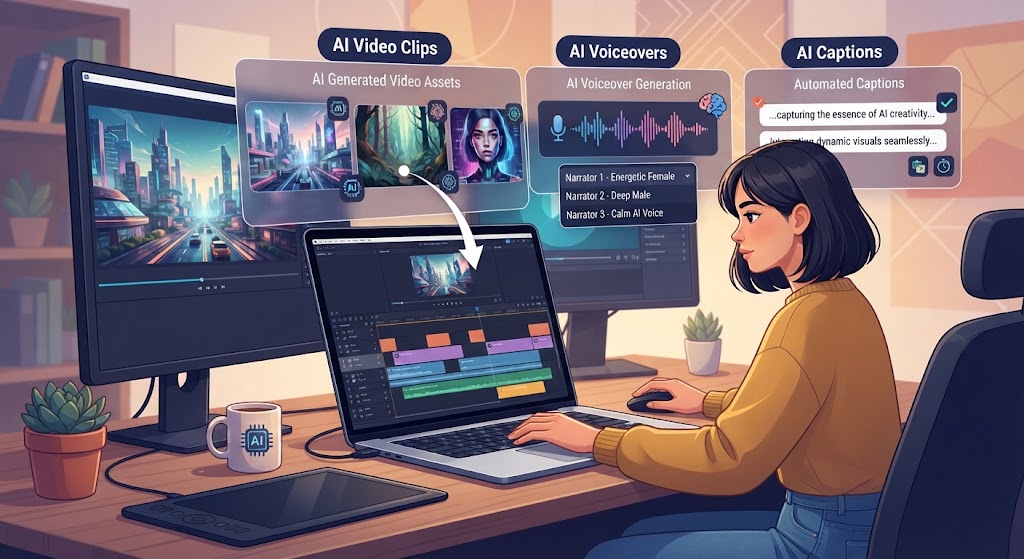
AI video creator jobs have moved from a niche freelance gig to one of the fastest-growing corners of the content industry. Brands, agencies, and media companies now need people who can direct AI tools like Runway, Pika, and Sora to produce ads, explainers, and social content in a fraction of the time traditional editing takes. If you're weighing whether to break into this field, this guide covers what the role actually involves, what it pays, the skills that get you hired, and a realistic path to landing your first job.
What Is an AI Video Creator, and Why Is Demand Growing in 2026
An AI video creator combines traditional video storytelling skills with AI generation and editing tools to produce finished video content in a fraction of the time a full production crew would need. Instead of shooting and manually editing every frame, they write prompts, direct AI-generated footage and voiceovers, and assemble the pieces into a polished final cut. Demand has grown quickly because marketing teams are under pressure to publish far more video content than their budgets or headcount can support, and AI video tools let a single skilled operator do work that used to require an entire crew.
What AI Video Creator Jobs Actually Pay
Pay varies widely based on experience and whether the work is freelance or full-time. Freelancers typically charge anywhere from $50 to $300 per finished short-form video, depending on complexity and turnaround time. Entry-level, in-house AI video creator roles at agencies and startups tend to start in the $45,000 to $65,000 range, while experienced creators who can also handle strategy, motion graphics, or team leadership can push well past $90,000. Specialized skills, such as AI voice cloning or brand-safe prompt engineering, command a premium in both freelance and salaried roles.
Core Skills Employers Look for in AI Video Creator Jobs
Employers consistently look for a mix of creative and technical ability: strong storytelling and pacing instincts, comfort writing detailed prompts that produce consistent results, basic motion graphics and color grading skills, and the judgment to spot when AI-generated footage looks off-brand or unrealistic. Just as important is speed. Teams hire AI video creators specifically to move faster than a traditional production pipeline, so the ability to turn around polished drafts in hours rather than days is often the deciding factor between candidates.
7 Tools Every AI Video Creator Should Know
Most job postings expect familiarity with a handful of tools:
Runway, for AI video generation and editing
Pika, for fast text-to-video generation
Sora, for higher-fidelity cinematic generation
ElevenLabs, for AI voiceover and voice cloning
HeyGen, for AI avatar and presenter-style videos
CapCut, for fast final-cut editing and captions
Descript, for script-based editing and cleanup
How to Land Your First AI Video Creator Job
Start by building a short portfolio of 3 to 5 sample videos that show range, such as a product ad, an explainer, and a social short. Post that work on freelance platforms and search job boards for titles like AI content creator, AI video editor, and multimedia producer, since AI video creator itself is still an emerging title that not every employer uses yet. Reaching out directly to small agencies and DTC brands with a short sample reel often works better than applying cold, since many of these teams are hiring for this skill set before they've formalized the job description.
Common Mistakes That Keep Candidates From Getting Hired
The most common mistake is submitting a portfolio that's all raw AI output with no editing, pacing, or brand polish applied, which signals a lack of the judgment employers are actually paying for. Other frequent missteps include ignoring licensing and usage rights on AI-generated footage, not being able to explain the prompt and editing process behind a sample, and applying only to postings that use the exact phrase AI video creator instead of the wider range of titles employers actually use.
Key Takeaways
AI video creator jobs pay anywhere from $50 to $300 per freelance video, or $45,000 to $90,000-plus in full-time roles.
Employers value editing judgment and speed over raw AI output.
Learn Runway, Pika, Sora, ElevenLabs, HeyGen, CapCut, and Descript to cover the full workflow.
Search beyond the exact job title, since AI video creator roles are often posted under other names.
A short, polished portfolio beats a long list of raw AI generations every time.
Frequently Asked Questions
Do I need a film or video degree for AI video creator jobs?
No. Most employers care more about your portfolio and turnaround speed than formal training. A strong reel built with AI tools can outweigh a degree in this field.
Is AI video creation a stable career path?
The tools will keep changing quickly, so stability comes from your storytelling and editing judgment rather than any one platform. Creators who treat tools as replaceable and skills as the constant tend to stay employable longest.
Can I start as a freelancer before going full-time?
Yes, and it's often the fastest way in. Freelance projects build your portfolio and give you real client feedback, both of which make full-time applications stronger.
Topezia's job board lists new AI video and content roles as they're posted, and the AI Career Coach can help you position your portfolio and target the right titles for your experience level.